
Common Mistakes in English Job Interviews (And How to Avoid Them)
Common mistakes in English job interviews and how to avoid them. Learn how to sound more confident and communicate clearly under pressure.
Common mistakes in English job interviews and how to avoid them. Learn how to sound more confident and communicate clearly under pressure.
This article is written in English to support your learning. Part 2 – the candidate’s perspective If you’ve ever walked out of an interview in English thinking,“I know I could have said that better,”you’re not alone. Many experienced professionals feel confident in their work, their expertise, and their decisions. But put them in a job […]
Steeds meer sollicitatiegesprekken vinden plaats in het Engels, vaak tussen mensen voor wie het geen moedertaal is. In deze blog lees je hoe het waargenomen niveau van zelfvertrouwen in Engelstalige interviews wordt beïnvloed door taalgebruik en culturele verwachtingen, en waarom wat als ‘twijfel’ wordt gezien, vaak simpelweg zorgvuldig formuleren is.
Veel professionals voelen zich prima in het Engels, totdat ze in een vergadering zitten. In deze blog lees je waarom Engelse meetings vaak lastig voelen en hoe je met eenvoudige aanpassingen zelfverzekerder kunt klinken, zonder te overdenken
In deze blog lees je welke Business English‑fouten Nederlandse professionals vaak maken in vergaderingen, e-mails en presentaties – en hoe je die met meer zelfvertrouwen kunt vermijden.
This article is written in English to support your learning. Let’s face it—between meetings, deadlines, and the occasional coffee spill, finding time to improve your Business English can feel impossible. But here’s the good news: you don’t need hours of study time to make real progress. With the right strategies, you can build your skills […]
Many Dutch professionals speak English extremely well. What they may actually be doing, though, is communicating in Dutch — using English words. And that’s not a bad thing! Dutch communication is known for being clear, efficient, and direct — which works brilliantly in many settings. But in international business, especially when English is the working […]
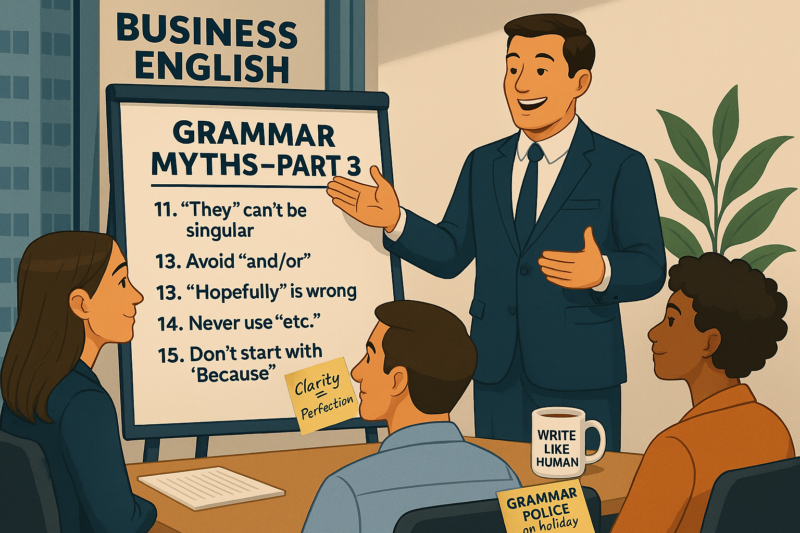
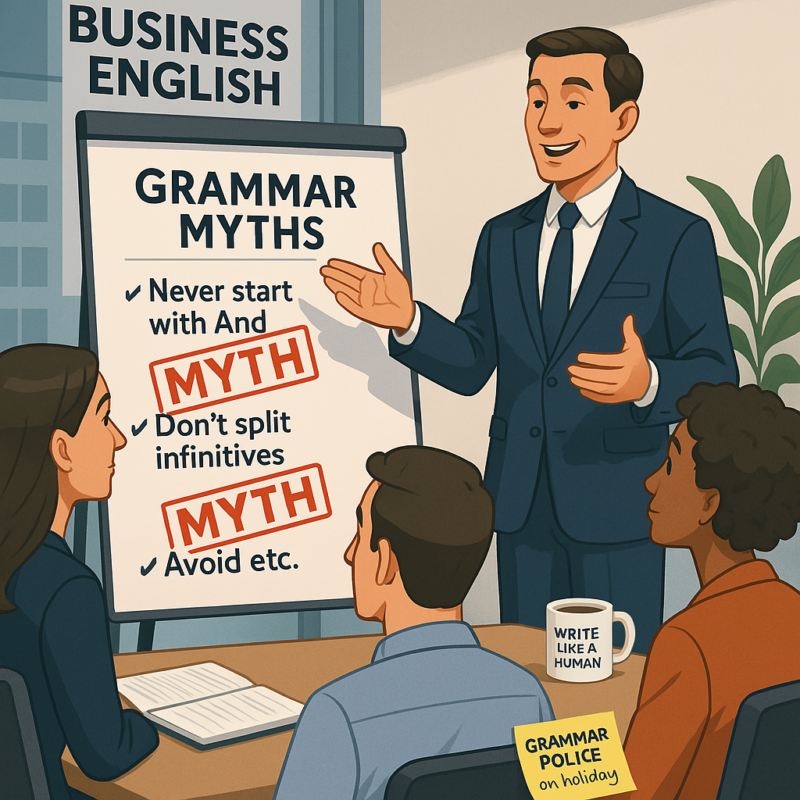
By now, you’ve probably realised that many of the “rules” we were taught about English aren’t rules at all. They’re myths—often outdated, sometimes misunderstood, and occasionally just made up. In this final part of the series, we’re tackling a few more that still trip people up in business writing. Myth 11: You must never use […]
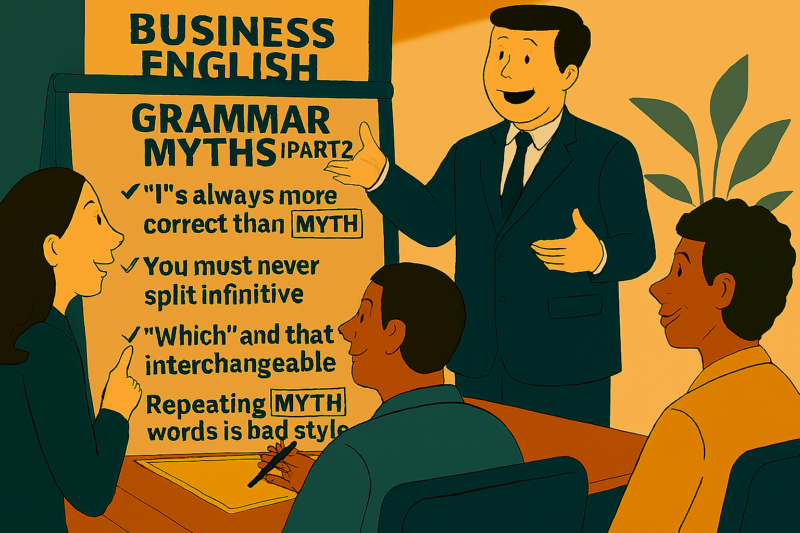
In Part 1, we tackled some of the most common grammar myths—like whether you can start a sentence with And, or end one with a preposition. (Spoiler: you can.) But there are more. And they’re just as persistent. Let’s keep going. Myth 6: “I” is always more correct than “me” The myth: You should always say “John and […]
We’ve all been there. You’re writing an email, a proposal, or a LinkedIn post—and suddenly, you hesitate.Can I start a sentence with “And”?Is it okay to use contractions?Will someone judge me for ending with a preposition? Business English is full of myths. Some are leftovers from school. Others come from well-meaning advice that’s no longer […]
Discover how storytelling—like Obama’s “Fired up!” speech—can transform your Business English communication, leadership, and language learning.
In Part 1, we explored how to future-proof your Business English in a world increasingly shaped by AI. But there’s a deeper layer to this conversation—one that goes beyond grammar and vocabulary. It’s about how we communicate as human beings in a digital world that often forgets what it means to be human.
We live in a world where technology is evolving faster than ever. Artificial Intelligence is writing emails, summarising meetings, and even holding conversations. It’s impressive—and a little overwhelming. But here’s the thing: no matter how advanced AI becomes, the art of human communication—talking, writing, listening—will always matter. In fact, it might matter more than ever.
In today’s globalised world, mastering Business English is more than a nice-to-have—it’s a career booster. But memorising endless lists of jargon and phrases? Not so fun. That’s where mind maps come in. These visual tools can transform your vocabulary learning from overwhelming to organised, creative, and even enjoyable.
Recently, I had the pleasure of spending a few days in Le Touquet Paris-Plage with my family. It’s a charming seaside town in northern France, and my French—while far from perfect—usually gets me by. I can hold a conversation with my French-speaking in-laws, and I can almost always follow what’s going on. So, when I asked the […]
Giving a presentation in English can feel like a double challenge: you’re not only sharing your ideas, but doing so in a second language. The good news? As a Dutch professional, your English is likely strong. But success isn’t just about language—it’s about how you prepare and how you connect with an international audience. If you’ve already explored how […]
When Dutch professionals switch to English in the workplace, it’s not just the vocabulary that changes—it’s the culture behind the language too. While the Netherlands is known for its high English proficiency, subtle differences in tone, formality, and communication style can lead to misunderstandings or missed opportunities. Here’s how to navigate the shift from Dutch to English […]














 French
  English
  Dutch
Dutch